Sherwin-Williams Commercial Window Tinting in Newark, Delaware
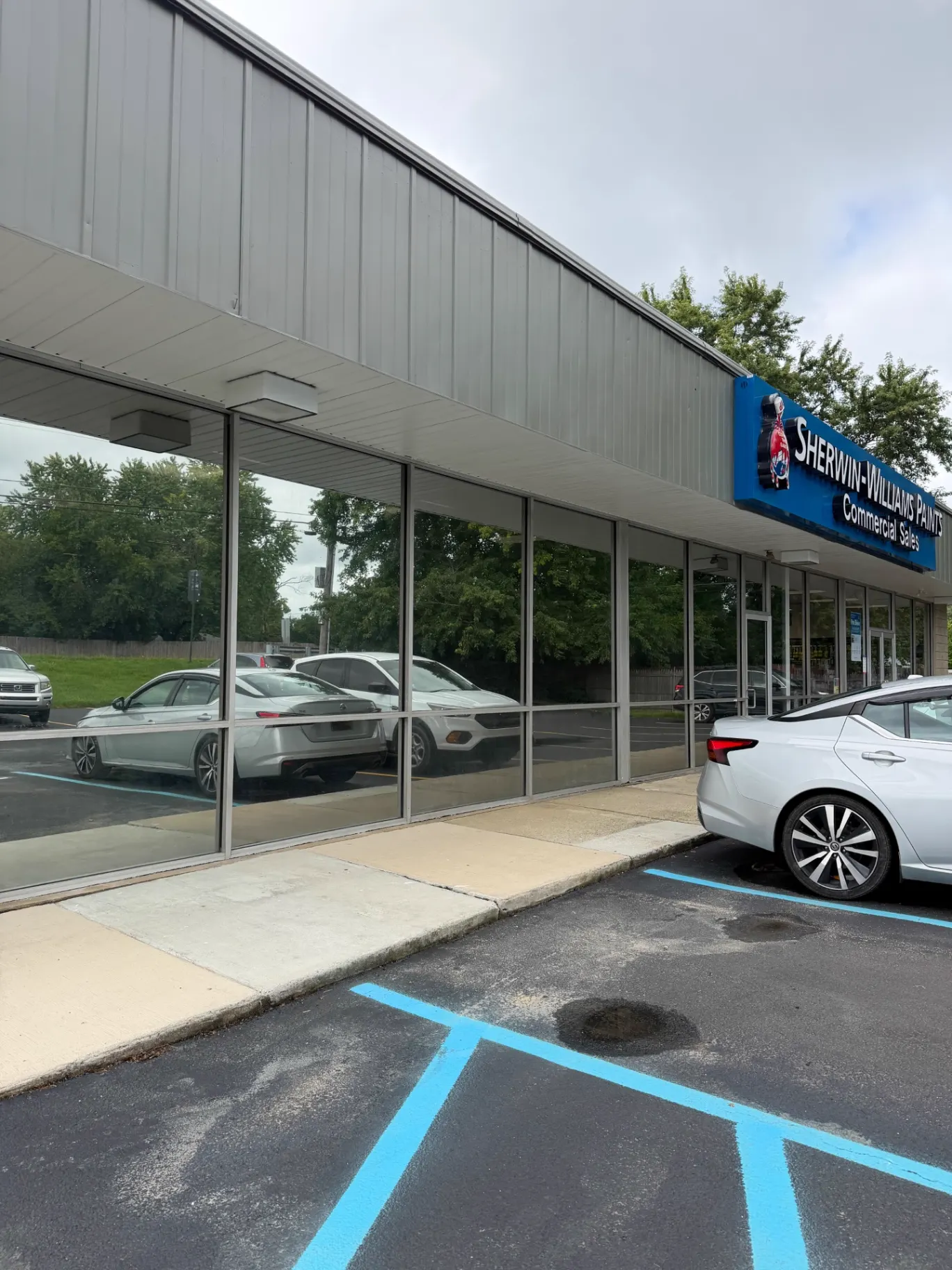
Roughly 500 square feet of storefront glass at a Sherwin-Williams commercial location in Newark, Delaware, treated with 3M reflective commercial window film for stronger daytime privacy, solar heat control, and glare reduction.
- Glass treated
- ~500 sq ft
- Film
- 3M reflective commercial film
- Location
- Newark, DE
Project snapshot
- Client
- Sherwin-Williams commercial location
- Location
- Newark, New Castle County, Delaware
- Sector
- Retail / commercial storefront
- Scope
- Approximately 500 sq ft of storefront glass
- Product
- 3M reflective commercial window film
- Project target
- ~70% heat reduction and ~85% glare reduction (specification target)
- Goals
- Daytime privacy, solar heat control, glare control
The challenge
A paint and coatings location is a working commercial space behind full-height glass. Interior walls, racking, and stored product sit in direct view from outside, and the same glass runs the length of the customer-facing elevation.
The stated goals for the job were to conceal the view into the building and its interior walls, improve daytime privacy, and cut the solar heat and glare coming through the storefront glass.
The project called for a more private, uniform storefront appearance while targeting approximately 70% solar heat reduction and 85% glare reduction across roughly 500 square feet of glass.
Project objectives
- Conceal the exterior view into the building and its interior walls
- Improve daytime privacy through the storefront glass
- Give the glass one uniform, intentional appearance
- Target roughly 70% solar heat reduction across the treated glass
- Target roughly 85% glare reduction across the treated glass
Why this solution
Reflective window film was the right specification here because the goals were visual and thermal at the same time. A reflective film puts a mirrored exterior surface on the glass that rejects a large share of solar energy before it enters the building, while also making the glass far harder to see through from outside in daylight.
Reflective film gives its strongest privacy effect when the outside is brighter than the inside — the normal condition for a retail storefront during business hours. It is a daytime privacy product, not a 24/7 one-way mirror; once the interior is lit and the exterior is dark, that effect diminishes and can reverse.
Because the film is applied to existing glass, the storefront was upgraded without glazing replacement and without changing the storefront system.
The exact 3M reflective series used on this project is not published here — we do not list a product model we cannot verify from the job record.
Installation approach
- 1
Standard Shore Tint commercial process, shown here as how we approach a storefront of this type — specific scheduling details for this job are not published.
- 2
Site walk of the glass to confirm sizes, condition, framing, and the roughly 500 square feet in scope.
- 3
Each lite measured and the film cut to that opening — storefront runs are rarely identical across an elevation.
- 4
Glass fully cleaned and prepped so no debris is trapped under the film, which is the single most common cause of a failed commercial install.
- 5
Film installed lite by lite, edges trimmed to the frame, and each pane squeegeed out to remove mounting solution.
Results
- Approximately 500 sq ft of glass treated with 3M reflective commercial window film
- A uniform reflective exterior across the customer-facing glass
- Reduced daytime visibility into the interior and its interior walls from outside
- Solar heat and glare control targeted at roughly 70% and 85% respectively per the project specification — targets for the film and job, not field-measured building energy savings
- No glazing replaced — the existing storefront system was kept
Project photos
Real photos from this project or program. Tap any image to view it larger.
Commercial window tinting in Newark and New Castle County
Newark's commercial corridors — Main Street, Kirkwood Highway, and the Christiana retail area — are full of the same storefront profile: aluminum-framed full-height glass facing a parking field. That glass is usually the largest thermal and privacy weak point in the building.
Reflective and solar films are the most common answer we specify for that condition across New Castle County: no glazing replacement, no construction, and a visible change to how the storefront reads from the lot.
Related applications
Sherwin-Williams — frequently asked questions
Have a similar building or portfolio?
Send us the scope, the plans, or just a few photos. We survey, specify, and install across Delaware and the Maryland Eastern Shore.
- Response within one business day
- 3M Authorized Dealer · IWFA accredited
- Serving Delaware since 1989