Glass-to-frame attachment / specification guide
Glass retention starts at the edge.
Film, glass and frame meet at a critical perimeter. Review the connection before specifying the performance.
Conceptual cutaway · not to scale
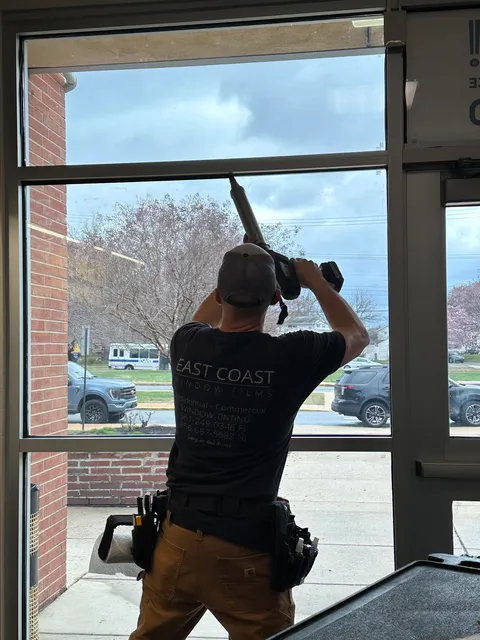
Seaford district scope: 500 sq ft of security film; approximately 480 linear feet of 3M IPA.
View the installation record01 / Reviewing your glass and frames
The connection at the perimeter
Film helps bind fragments after glass breaks. A specified attachment connects that filmed glass to a compatible frame. Without an appropriate connection the filmed sheet may leave the opening; with a connection, performance still depends on the glass, film, attachment, frame and exact tested application.
The conceptual detail on this page explains the relationship of those parts. It is not a construction detail, tested assembly, bead-width specification or do-it-yourself installation instruction.
Film only
Fragment binding without a specified perimeter connection. The filmed sheet may still leave the opening.
Film + specified attachment
A compatible connection to a suitable frame. Not an automatic rating or guarantee of retention.
02 / Reviewing your glass and frames
Compatibility before a perimeter specification
Survey the frame material, profile, glazing bite, existing gaskets and sealants, surface condition and access. A frame that looks sound in a photograph may not provide a suitable bonding surface. Existing finishes and edge appearance also belong in the scope.
The attachment method, preparation and cure sequence must follow the current manufacturer instructions for the actual film and frame. Do not choose a bead size or substitute sealant from a generic diagram. Review incompatible surfaces or deteriorated framing before deciding a retrofit is feasible.
03 / Reviewing your glass and frames
Application-specific 3M requirements
Ultra S800 requires 3M IPA for break-entry, windstorm, explosion mitigation and spontaneous breakage on single-pane tempered glass. 3M limits its explosion applications to commercial and non-educational government facilities, not schools.
The S2400 US product page specifies IPA for all applications. Its July 2026 technical specifications describe particular application scopes and tested configurations; those results do not replace the all-applications product-page requirement. Do not combine PET-based film with S2400 on the same pane.
Keep the source scopes distinct
Application requirements and a specific tested configuration are not interchangeable. Read the current product page alongside the technical specification, then document the actual opening.
3M Scotchshield S2400 — US product requirements04 / Reviewing your glass and frames
Preparation, curing and the final record
Confirm cleaning, film installation, perimeter preparation, attachment and curing with the selected manufacturer instructions. Agree access protection and phasing before work begins. Discuss the edge finish and any needed sample detail without treating a sample as proof of tested performance.
Closeout should identify the installed film and attachment, opening schedule, applicable manufacturer documentation, care and curing instructions, warranty terms and acceptance records. Inspector/AHJ safety-glazing acceptance is a separate question from a security assembly’s test report.
Opening-by-opening closeout
- Glass, film and attachment identification
- Relevant tested-configuration documents
- Care, curing and warranty documentation
- Owner acceptance and inspector records, where applicable
Manufacturer documents
Reviewed November 6, 2026. Manufacturer requirements apply to the specified product, glass and installation.
Frequently Asked Questions
Next step
Review your glass, film and frame together.
Start with the openings and the objective. Shore will document the glazing scope and the applicable installation requirements.