Window Film for Oceanfront Condos: Heat Control Without Losing the View
Choosing window film for a beachfront condo: heat and glare priorities, visible light and reflectivity, fading, HOA approval, glass compatibility, warranties and building access.
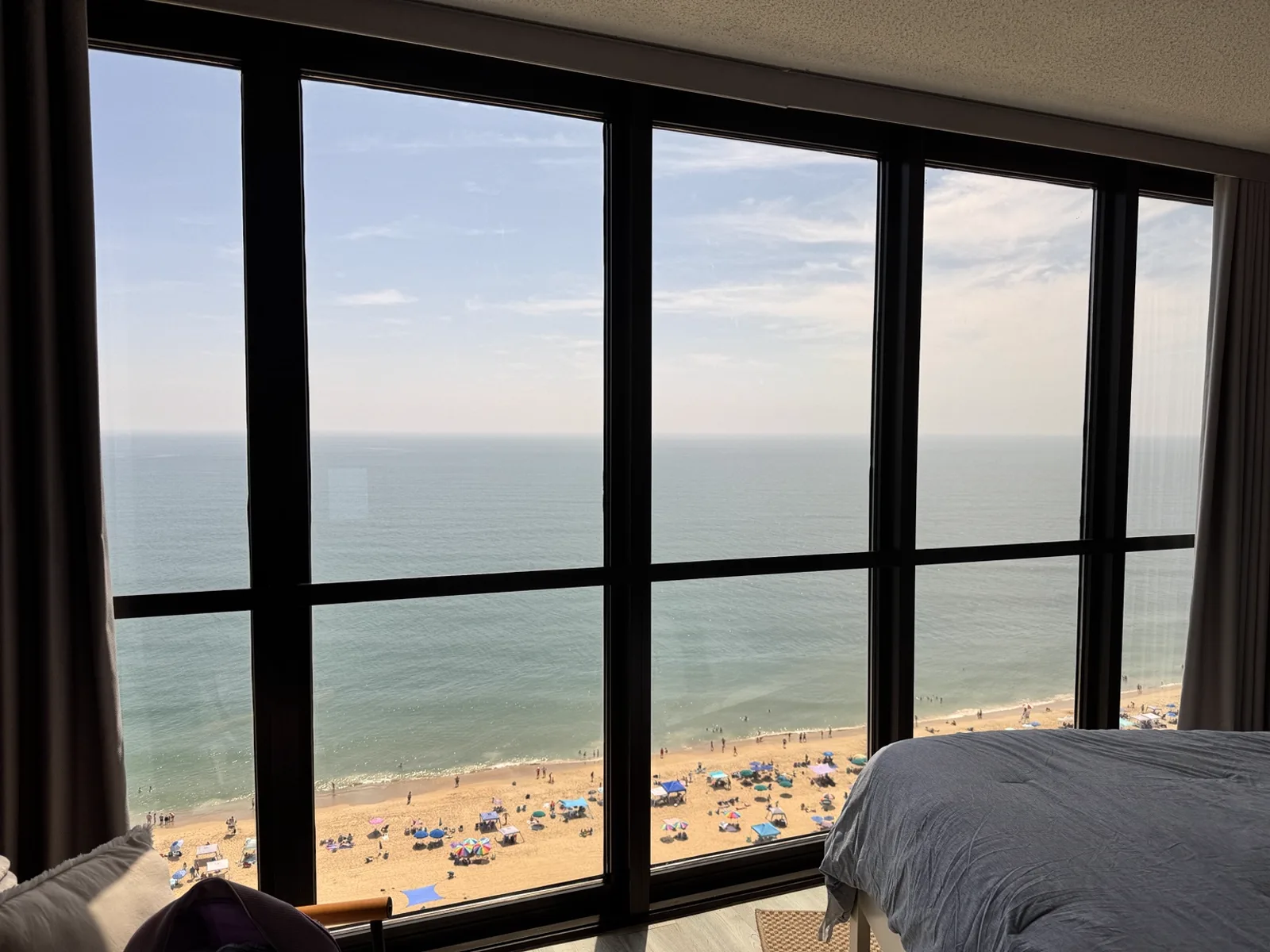
Short answer: for an oceanfront condo, the film decision is a trade-off between solar heat control and how much the glass changes visually. High visible-light-transmission, low-reflectivity films exist specifically for view-first rooms — they are chosen so the window wall still reads as glass, not as tint. Everything else — HOA approval, glass compatibility, access, warranty — should be settled before a roll is ordered.
A beachfront unit is built around one wall. The ocean is the reason the room exists, and any treatment that dulls it defeats the purpose. But that same wall is where unobstructed coastal sun over open water lands with nothing in the way. This guide walks through how to think about it, using a completed Sea Colony project in Bethany Beach as the example.
Start with the actual complaint
"Too hot" and "too bright" are different problems with different answers, and rooms often have both:
- Solar heat. The room warms up faster than the HVAC can keep up, or one zone near the glass is always warmer than the rest of the unit.
- Glare. Screens wash out, and there are hours of the day when a specific seat is unusable.
- Fading. Flooring, art, and upholstery near the glass are showing wear the rest of the unit is not.
- Privacy. Usually a lower priority in a high-floor beachfront unit, but a real issue on ground-level or courtyard-facing glass.
Rank them before you shop for a product. A film chosen for heat is not necessarily the film chosen for glare, and a film chosen for privacy will almost always change how the view looks.
Visible light and reflectivity: the two numbers that decide the look
Two published values control whether a condo owner is happy afterward.
Visible light transmittance (VLT) is the percentage of visible light the glass and film let through. High-VLT films are the ones that keep a room bright and a view clear. Low-VLT films are darker and are chosen where appearance change is acceptable.
Reflectivity — interior and exterior — determines whether the glass mirrors. Interior reflectivity is what turns your window into a mirror at night; exterior reflectivity is what the building looks like from the beach. For a view-first room, low reflectivity on both sides is usually the priority, and it is also what most HOAs care about.
Modern multi-layer films are engineered to reflect infrared energy while transmitting visible light, so heat rejection no longer requires a dark or mirrored product the way it once did. That distinction is the whole reason a beachfront unit can get solar control without losing the view.
A real example: Sea Colony, Bethany Beach
At a private Sea Colony condominium in Bethany Beach, approximately 120 square feet of beachfront glass was treated with 3M Prestige 70. The owner's goal was temperature and solar heat control, with a hard constraint: the film could not darken the room or make the glass read as tinted.
3M describes the Prestige series as a high visible-light-transmission film with low interior and exterior reflectivity. The Prestige films are non-metalized, so there is no metal layer subject to corrosion and no interference with phone or wireless signal — a relevant point in a coastal building. Per the 3M Prestige 70 technical data sheet, the film rejects 99.9% of UV rays; that is the manufacturer's published figure for the product, not a measurement taken on this job.
No measured temperature or energy figures were recorded on that job, so none are published. What the photos and video do show is that clear outward views remain through the treated glass and the room still reads bright.
Full scope, photos and FAQs: 3M Prestige 70 window film in a Sea Colony beachfront condo.
Fading: what film can and cannot do
Fading is caused by ultraviolet light, visible light, heat, and time. Quality solar films block the large majority of UV — manufacturers publish that figure — and reduce solar heat, which addresses two of the four factors. They do not stop fading entirely, because visible light itself fades materials. Any installer who promises your floors will never fade is overselling. The honest framing: film substantially reduces one of the primary drivers and slows the process.
HOA and building considerations
In a condominium, the glass is often a limited common element and the exterior appearance is almost always governed. Before signing anything:
- Check the governing documents for window treatment, film, and exterior appearance provisions.
- Ask whether a specific product, VLT, or reflectivity level is already approved. Many beach communities standardize so the building looks uniform.
- Confirm the approval process — some associations require written architectural review with the product data sheet attached.
- Ask about existing glazing warranties. If the association or developer holds a warranty on the glass, film may interact with it.
- Confirm building access rules — elevator reservations, protection of common corridors, work hours, and parking or loading for a contractor.
None of that is bureaucratic overhead. Getting an association sign-off in advance is what prevents a film from having to come back off.
Glass compatibility on coastal buildings
Coastal condo glazing is frequently insulated glass, sometimes with a low-E coating, and often large. All three matter:
- Insulated glass units absorb and hold heat differently than monolithic glass; film selection has to account for thermal stress in the specific unit.
- Existing low-E or reflective coatings limit which films can be applied and can rule out some products entirely.
- Large lites and shading patterns from balconies, columns and railings create uneven heating across a pane, which is a thermal-stress input.
- Seal condition. A unit with a failed seal needs glazing repair first — film is not a fix for fogged glass.
A dealer should check your exact glass makeup against the film manufacturer's compatibility guidance before quoting a product, and should tell you plainly if a preferred film is not appropriate for your units.
Warranty and installation quality
Ask for the manufacturer's written warranty for the specific product and application, and ask what the installing company warrants separately. Do not accept verbal summaries of coverage terms — read the document. Installation quality is what determines whether you notice the film at all: measurement of each opening, clean glass preparation, edge trimming to the glass line, and a pane-by-pane inspection at the end.
Access and site logistics in a beach building
- Elevator and corridor protection — most buildings require it, and it should be in the quote.
- Furniture and flooring protection along the glass line, which is usually the entire room in a beachfront unit.
- Balcony sliders and fixed panels — confirm which openings are in scope, including transoms and side lites.
- Seasonality — rental turnover windows and off-season scheduling are usually easier for everyone.
Checklist before you commit
- What is the ranked problem — heat, glare, fading, privacy?
- What VLT and interior/exterior reflectivity is being proposed, and what will the view look like at those values?
- Is the product non-metalized, and does that matter for signal or corrosion concerns in your building?
- Has the exact glass makeup been checked for film compatibility and thermal stress?
- Does the HOA approve this product and appearance, in writing?
- What is the manufacturer's written warranty, and what does the installer warrant?
- Which published figures are manufacturer data on reference glass, versus anything claimed about your specific unit?
- How will the unit and common areas be protected during installation?
- Are all openings included — sliders, fixed panels, transoms?
- Is the installer an authorized dealer for the product being specified?
Related pages
- Residential energy efficiency and heat control
- Residential UV and fade protection
- Window tinting in Bethany Beach and across Sussex County
- 3M window film technical resources — published specifications and data sheets
Frequently Asked Questions
Will window film ruin the ocean view from my condo?
Not if the product is chosen for it. High visible-light-transmission, low-reflectivity films are made for view-first rooms. At the Sea Colony project, 3M Prestige 70 was specified specifically because the film could not darken the room or make the glass read as tinted.
What window film is best for an oceanfront condo?
There is no universal answer — it depends on your glass, your ranked priorities and your HOA rules. For a heat-control job that must preserve the view, a high-VLT low-reflectivity product like the one used at Sea Colony is the typical direction. Product selection should follow a compatibility check on your actual glazing.
Does window film interfere with cell or Wi-Fi signal?
Metalized films can. Non-metalized constructions avoid a metal layer entirely — 3M describes the Prestige series as non-metalized, with no metal layer subject to corrosion and no interference with phone or wireless signal.
Will film stop my floors and furniture from fading?
It substantially reduces UV, which is one of the main causes, and it reduces solar heat. It does not eliminate fading, because visible light and time also cause it. Manufacturers publish UV rejection figures — for 3M Prestige 70 the technical data sheet lists 99.9% UV rejection.
Do I need HOA approval to install window film in a condo?
Usually yes. Exterior appearance is typically governed in condominium documents, and many beach associations specify or pre-approve particular products. Get the approval in writing before installation is scheduled.
Can film be installed on insulated or low-E glass?
Often, but not always, and not with every product. Insulated units and coated glass change both the compatibility and the thermal-stress picture, so the specific glass makeup has to be checked against the manufacturer's guidance before a film is specified.
Talk to us about your unit
We work throughout the Delaware beaches, including Bethany Beach, Sea Colony, Rehoboth, Dewey and Fenwick. Request a free estimate or call (302) 947-4624 and we will look at your glass, your view, and your association's rules together.
Related Service:
Learn more about Residential Energy EfficiencyReady to Transform Your Space?
Contact us today for a free consultation and estimate.
Get a Free Estimate