Sunroom Window Tinting in a Schell Brothers Home at Coastal Club, Lewes
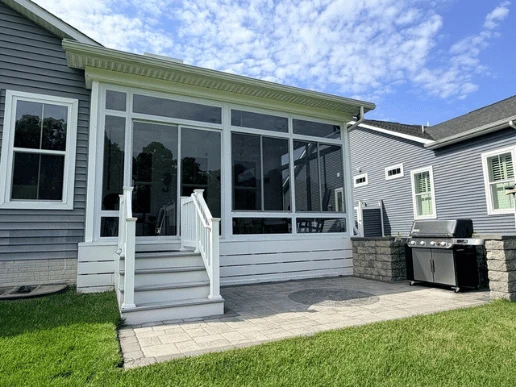
Approximately 200 square feet of sunroom glass in a Schell Brothers home at Coastal Club in Lewes, Delaware treated with 3M Sun Control Window Film Ceramic Architectural Series 45 — a low-reflectivity ceramic film chosen to cut solar heat and UV while keeping the room bright and the exterior glass looking natural rather than mirrored.
- Glass treated
- ~200 sq ft
- Film
- 3M Ceramic 45 (CA45)
- UV rejected
- 99.8%
Project snapshot
- Client
- Private residence (homeowner not identified)
- Location
- Coastal Club — Lewes, Sussex County, DE
- Builder
- Schell Brothers
- Space
- Sunroom / four-season room
- Scope
- Approximately 200 sq ft of sunroom glass
- Product
- 3M Sun Control Window Film Ceramic Architectural Series 45 (CA45)
- Goals
- Solar heat and UV control without a dark or mirrored look
The challenge
A sunroom is mostly glass by design, and that is exactly what makes it uncomfortable in summer. Sun enters from several directions at once, there is very little insulated wall area to buffer it, and the room heats faster than the rest of the house — often to the point where the space goes unused through the middle of a warm day. In newer Coastal Club phases there is very little mature tree cover to soften that.
The homeowner did not want to solve it by darkening the room. The whole point of the sunroom in a Schell Brothers floor plan is the daylight and the view out to the yard and patio, so a deep-shade film was off the table.
They were equally clear about the exterior. A highly reflective film would have turned the sunroom into a black mirror from the patio and the street, which would have looked wrong against the white frames and light siding — and out of place on a Coastal Club elevation.
Project objectives
- Reduce solar heat gain across a glass-heavy sunroom
- Cut ultraviolet light reaching furnishings, flooring, and textiles
- Keep the room bright and the outward view clear
- Avoid a dark, shiny, mirrored exterior appearance
- Treat the existing glazing rather than replace it
Why this solution
3M Sun Control Window Film Ceramic Architectural Series 45 fits this brief precisely. It is a ceramic-based, non-metallized sun control film built to reject solar energy while holding onto a high level of visible light — the opposite trade-off from a dark reflective film.
Current 3M technical data for CA45 on 1/4-inch clear glass lists 45% visible light transmission, 52% total solar energy rejected, 41% solar heat reduction, 99.8% UV rejected, and 49% glare reduction. Those figures are tied to that specific glass condition: performance shifts with the glazing it is applied to, so we specify against the actual glass rather than quoting one number for every window. 3M's Ceramic Architectural family page notes the series can block up to 55% of heat depending on the film and glass combination.
For this sunroom that means roughly half of the total solar energy hitting the treated glass is rejected and over 99% of ultraviolet light is blocked, while 45% of visible light still comes through. It is a heat-and-UV answer, not a darkening one.
Appearance was the deciding factor. CA45 carries approximately 6% exterior visible light reflectance — close to the reflectance of ordinary glass — so the sunroom does not read as a mirror from outside. Reflective solar films can run several times that, which is what produces the shiny, silvered look the homeowner wanted to avoid.
Because the film is non-metallized, it also does not interfere with cell, Wi-Fi, or other signals the way some metallized solar films can.
Installation approach
- 1
Walked the sunroom, confirmed the glass type and the orientation of each elevation, and measured the full glass area at approximately 200 square feet.
- 2
Reviewed shade options with the homeowner against the appearance requirement — light transmission and exterior reflectance, not just heat numbers.
- 3
Prepared and cleaned every pane. On a room with this much continuous glass, prep is what decides whether the finished wall of glass looks uniform.
- 4
Cut and applied 3M Ceramic Architectural 45 pane by pane across the sunroom glazing, including the tall fixed panels and the door glass.
- 5
Detailed edges and checked the room panel to panel from inside and from the patio, so the glass reads as one consistent finish.
- 6
Final walkthrough plus aftercare guidance for the initial cure period.
Results
- Approximately 200 sq ft of sunroom glass treated with 3M Ceramic Architectural 45
- Roughly half of total solar energy rejected at the treated glass, based on 3M's published CA45 data for clear glass
- 99.8% of ultraviolet light rejected, reducing a major contributor to fading of furnishings and flooring
- 45% visible light transmission — the room stays bright and the view to the yard stays clear
- Approximately 6% exterior reflectance, so the sunroom keeps a natural, non-mirrored look from the patio
- Existing glass, frames, and doors left in place
Project photos
Real photos from this project or program. Tap any image to view it larger.
Window film for Coastal Club and Lewes sunrooms
Coastal Club is a Schell Brothers community off the Route 9 corridor in Lewes, and the glass packages there are exactly why sunroom film calls come from this neighborhood so often: wide rear elevations, sunrooms and morning rooms, and newer phases with very little mature tree cover to shade them. The room built for the view is frequently the room nobody sits in from late morning through the afternoon.
The instinct is to reach for the darkest film available. In practice most homeowners regret that in a sunroom, because it takes away the daylight and the view they paid for. A mid-range ceramic film is usually the better balance — meaningful solar energy and UV rejection with the room still reading bright.
Appearance from the outside deserves the same attention in a community like this one. Reflective films work, but on a sunroom facing a patio or a street they look distinctly mirrored from every angle of the yard. Low-reflectivity ceramic films avoid that and keep the elevation looking the way the builder intended.
One practical note: glass type matters. Insulated, low-E, tempered, and annealed glass all behave differently with film, and published performance figures are tied to a specific glass condition. We confirm the glazing before recommending a film rather than applying one spec sheet to every window.
Shore Tint & More is an independent 3M window film contractor. Schell Brothers is the home builder for this featured Coastal Club residence; the film work was contracted separately by the homeowner.
Private residence, Coastal Club — Lewes, DE — frequently asked questions
Want the same protection on your windows?
Send us a few photos of your rooms and windows. We measure on site, recommend a shade that fits the space, and film arched and odd-shaped glass in house across Delaware and the Maryland Eastern Shore.
- Response within one business day
- 3M Authorized Dealer · IWFA accredited
- Serving Delaware since 1989